
How to Search Cabarrus County Court Records
Court case searching for Cabarrus County runs through the North Carolina eCourts Portal. The state moved every county onto one system. The Judicial Branch eCourts page confirms that North Carolina finished its eCourts rollout in all 100 counties on October 13, 2025, and that all counties use the Enterprise Justice (Odyssey) case system. Cabarrus went live earlier, on October 14, 2024. The main tool is Smart Search, which pulls a near real-time case summary the system calls the Register of Actions.
You do not need an account to look. Anyone can search and view public case information without registering. Before you start, it helps to have the full party name or, better yet, the case number. North Carolina case numbers have four parts: a two-digit year, case-type letters, a six-digit sequence number, and a three-digit county code, like 21CR000003-910.
The official Portal training page explains Smart Search, Search Hearings, and NC Judgment Search. Here is the basic path.
- Open the North Carolina eCourts Portal in Chrome or Microsoft Edge.
- Use Smart Search. Type a case number in the state format, or a party name. Name wildcards need at least three last-name letters and one first-name letter before the asterisk.
- Open Advanced Filtering Options to narrow by Cabarrus location, case type, status, or filing date.
- Review the case summary. Sections show only when data exists, so a case with no balance may show no financial section.
- For a certified copy, contact the Cabarrus Clerk of Superior Court. The Portal is not the official court record.
The eCourts switch is recent, so a quick look at the state overview helps set expectations for what is online.
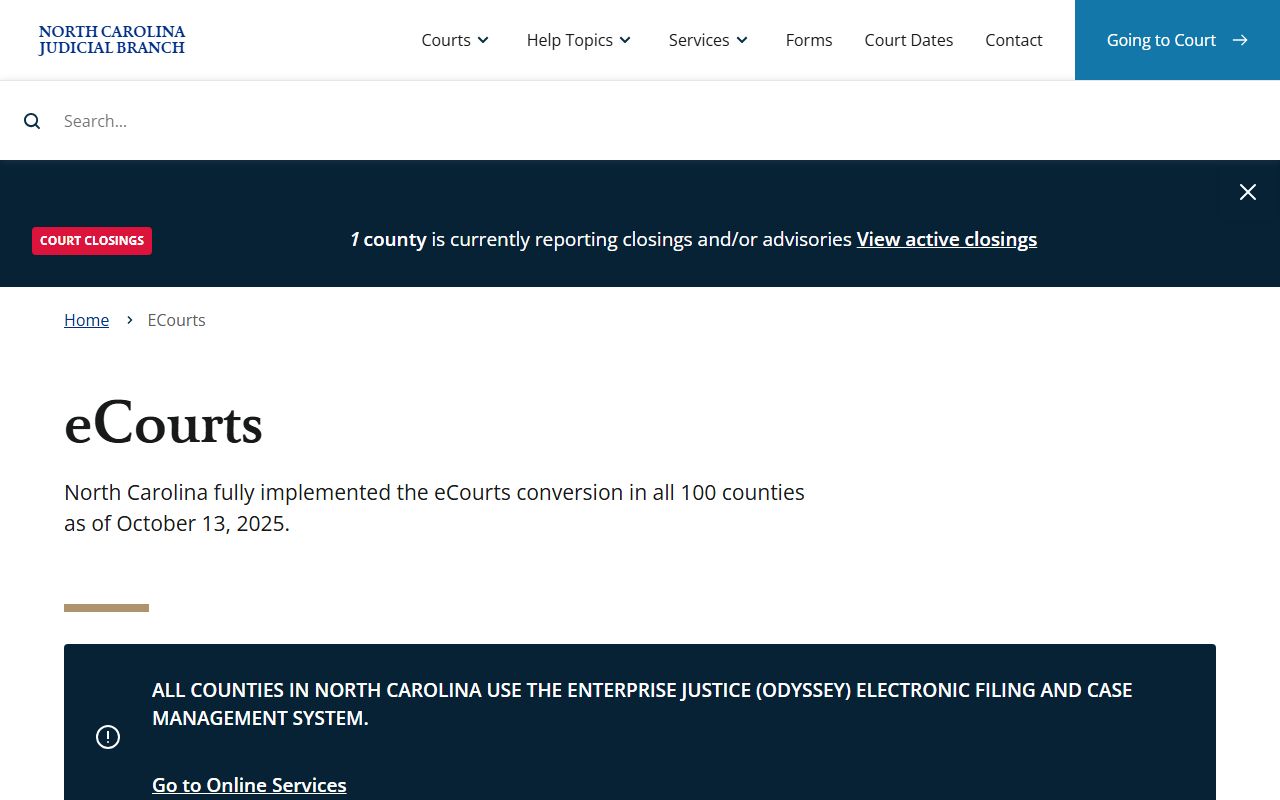
The portal landing screen is where every Cabarrus case search begins. You can see the live search interface on the eCourts Portal itself.
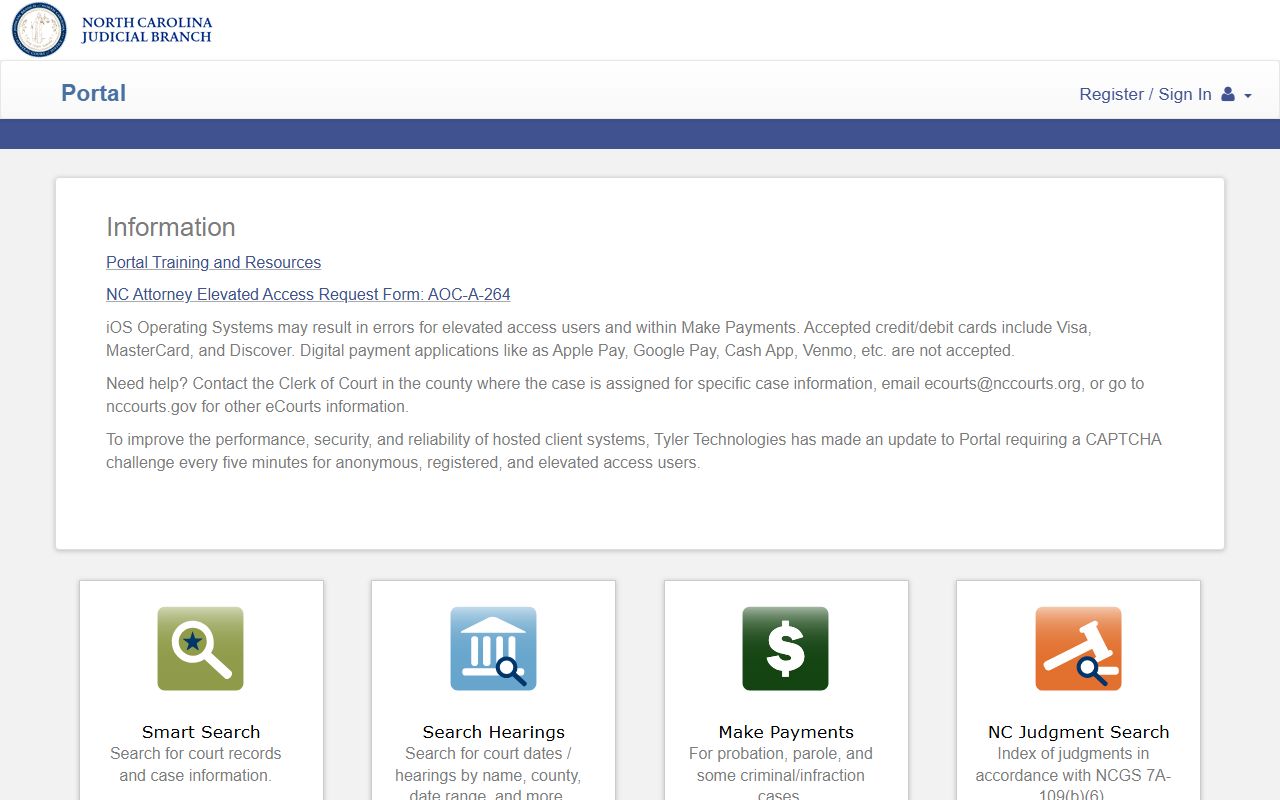
Smart Search is the front door. Search Hearings and NC Judgment Search cover court dates and judgment indexes.
Smart Search fields
These are the core fields the state portal uses for a Cabarrus case lookup.
| Field | Type | Required | Notes |
|---|---|---|---|
| Smart Search | Text | Yes | Case number or party name. |
| Case Number | Text | Optional | Wildcard needs four characters before the asterisk. |
| Party Name | Text | Optional | Returns all parties except victims. |
| Location | Dropdown | Optional | Choose Cabarrus to limit results. |
| Case Type / Status / Date | Filters | Optional | Found under Advanced Filtering Options. |
The Cabarrus County Judicial System
North Carolina runs one unified General Court of Justice. There is no separate county court system. The three divisions are the Appellate Division, the Superior Court Division, and the District Court Division. Cabarrus sits in Superior Court District 25, District Court District 25, and Prosecutorial District 25. The state structure of the courts page lays out how the levels fit together.
Superior Court is North Carolina's oldest trial court, set up in 1777. It handles felony cases, civil disputes over $25,000, and appeals from District Court. Judges rotate among districts every six months. District Court is the busier door for most residents. It hears misdemeanors, infractions, traffic, juvenile, family, domestic violence, and civil claims generally in the $10,000 to $25,000 range. Magistrates are District Court officers who handle first appearances, set release conditions, hear small claims, and perform civil marriages.
Case flow: Magistrate › District Court › Superior Court › North Carolina Court of Appeals › Supreme Court of North Carolina
| Court | Jurisdiction | Case Types |
|---|---|---|
| Superior Court | Higher trial court | Felonies, civil over $25,000, appeals from District Court |
| District Court | Lower trial court | Misdemeanors, traffic, family, juvenile, civil $10,000-$25,000 |
| Small Claims | Magistrate level | Money owed, evictions, possession of property |
| Court of Appeals | Intermediate appeals | Reviews trial records for legal error |
The state's own pages explain each level in plain terms. The Superior Court page covers felony and large civil jurisdiction.
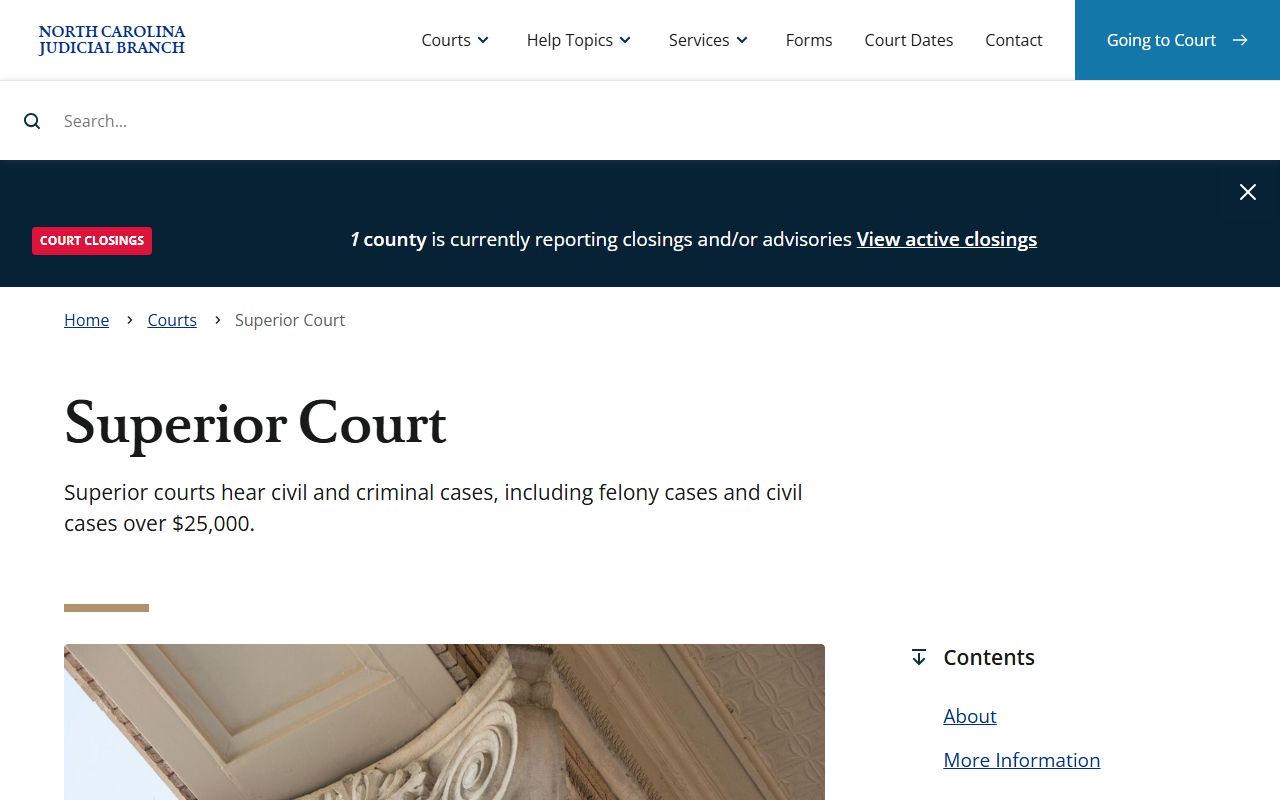
Superior Court is where Cabarrus felony and big-dollar civil files sit. District Court handles the higher volume of everyday cases, as the District Court page shows.
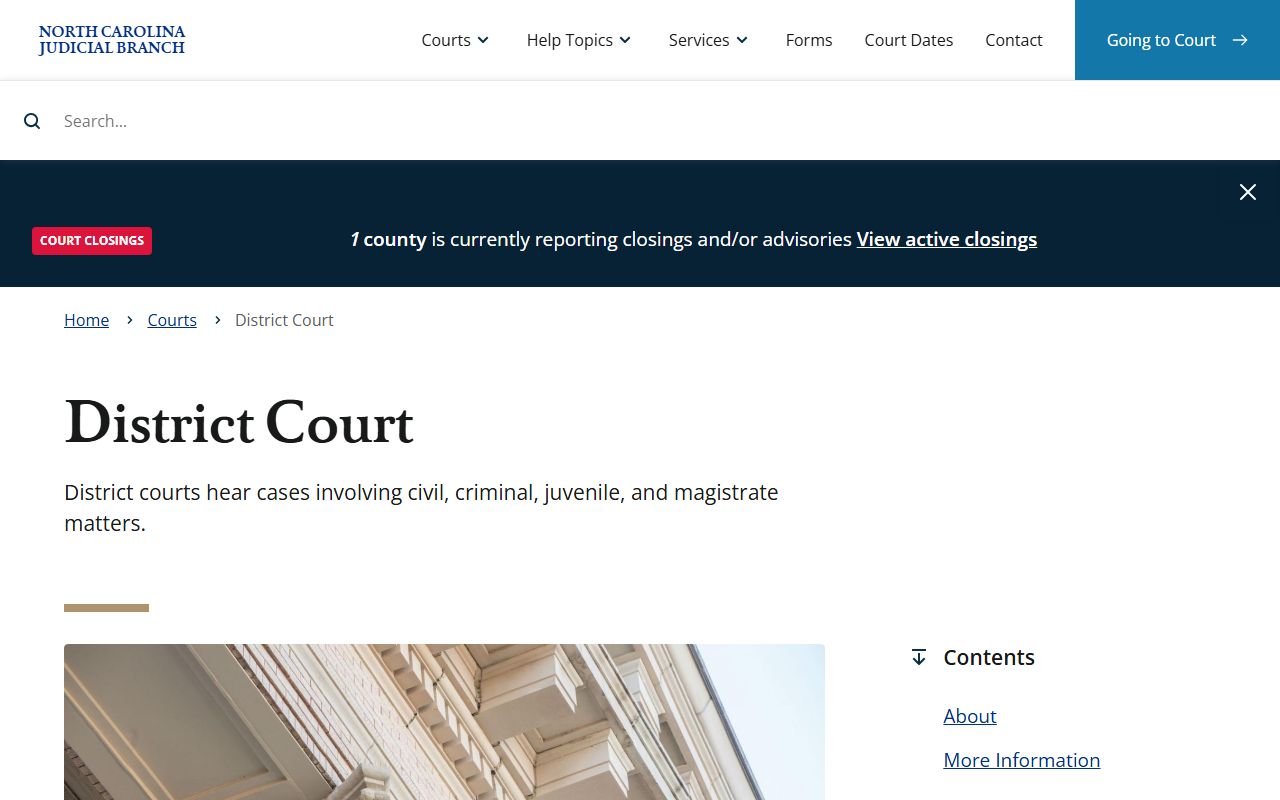
For a fuller breakdown of trial-court duties, see the Superior Court page on this site.
The Judicial Branch also keeps a broad court overview and a types of courts guide.
These overviews confirm the same hierarchy that applies in Cabarrus. The court types page adds detail on jurisdiction.
One more state page, the structure overview, ties the divisions together.
The takeaway is simple. Cabarrus cases follow state rules, not a local court code.
Cabarrus County Courthouse and Offices
Court users in Cabarrus move between three nearby buildings. The courthouse holds hearings and Clerk of Superior Court services. The Register of Deeds holds marriage licenses and vital records. The Sheriff's Detention Center holds jail and inmate services. Knowing where to go matters, because each office keeps a different kind of record. The county Judicial Branch location page ties the court services together.
That page lists court dates, local rules, and services in one spot. The official courthouse page adds the address, hours, and security rules.
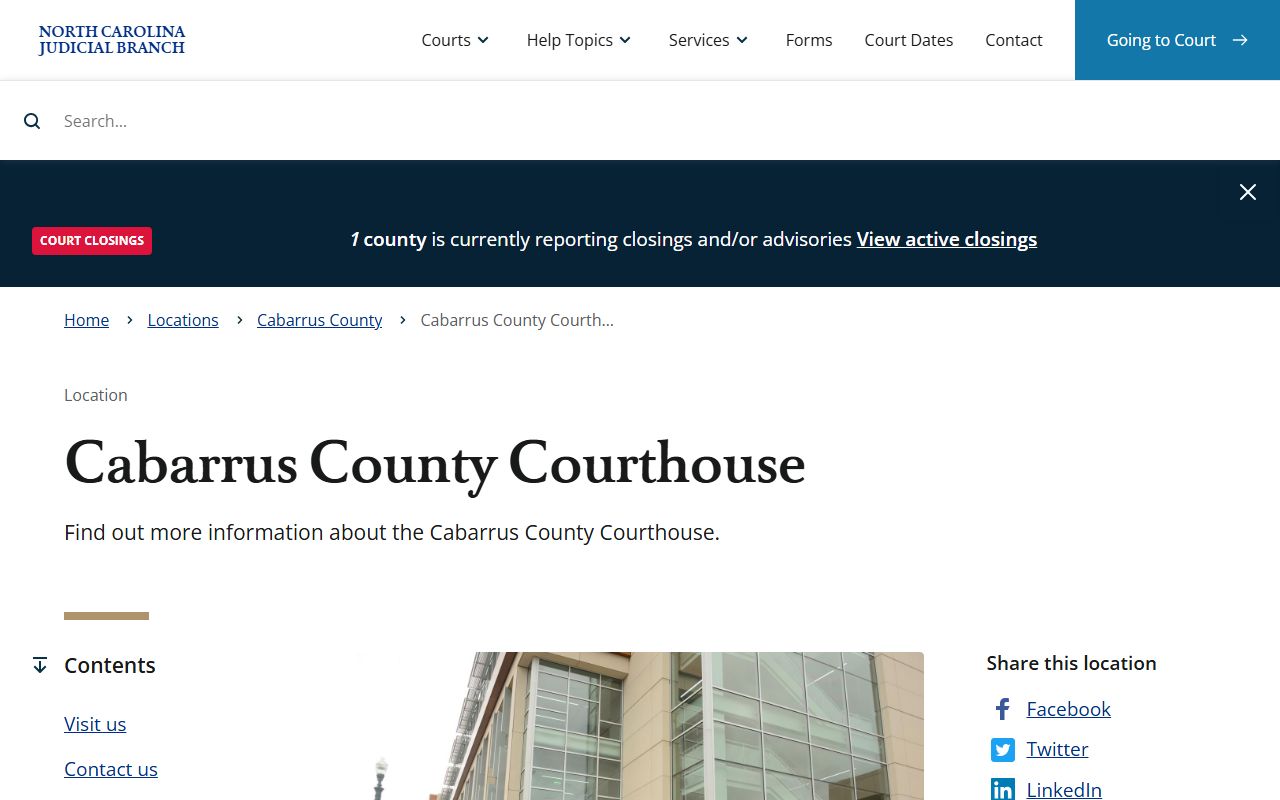
Note one thing before you visit: cell phones are not allowed inside the courthouse. Plan ahead.
Types of Court Records Available in Cabarrus County
The Cabarrus County Court produces many record types. Most are public. Some are sealed by law. Superior Court files lean toward felonies and large civil matters. District Court files cover the day-to-day work most people search for. The Clerk of Superior Court keeps the official versions of both.
The list below groups the main kinds of court records and which court produces them.
- Criminal records - felony files in Superior Court and misdemeanor, infraction, and first-appearance files in District Court.
- Civil records - complaints, answers, motions, orders, and judgments across both trial courts.
- Family records - divorce, custody, child support, and domestic violence orders in District Court.
- Probate and estate records - wills, estate administration, and guardianships before the Clerk.
- Traffic records - citations and infractions handled in District Court.
For a deeper look at any one type, the court records page walks through the search portal and the fields a case file shows.
What Cabarrus County Court Records Show
A Cabarrus case file is more than a name and a charge. The eCourts case summary, called the Register of Actions, lists the events in a case from filing to disposition. What you see depends on the case type and whether the data is public. The table below shows the common fields.
| Field | What It Shows |
|---|---|
| Case Number | Year, case-type letters, sequence number, and county code. |
| Filing Date | When the case was opened with the Clerk. |
| Parties | Plaintiffs, defendants, and attorneys, but not victims. |
| Charges / Cause | Criminal charges or the civil cause of action. |
| Disposition | The outcome of a charge or claim. |
| Financial | Costs, fines, and balances when they apply. |
Social Security numbers and similar private data are kept out of public views. The portal does not validate Social Security numbers for any user.
Public Access Laws for Cabarrus County Court Records
North Carolina treats most government records as open. The public-records framework starts with Chapter 132 of the General Statutes. Court records also follow judiciary-specific rules in Chapter 7A. The Clerk's record duties and public indexes come from those statutes. The eCourts Portal gives public access to docket information, but the Judicial Branch is clear that the Portal is not the official record. Official copies come from the Clerk.
A few statutes do most of the heavy lifting for court-record access in Cabarrus.
Key Statutes:
N.C.G.S. § 132-1 - defines public records broadly as material made or received in public business.
N.C.G.S. § 7A-109 - governs the Clerk's record books, indexes, and what the public may see.
N.C.G.S. § 132-1.10 - supports redaction of Social Security and identifying numbers from internet records.
The public records page covers how to file a county request and what fees may apply.
Records That Are Restricted or Confidential
Not every court record is open. Several categories are sealed or limited by statute, even when most civil and criminal indexes stay public. Juvenile delinquency and abuse cases are restricted under Chapter 7B. Adoption files are confidential under Chapter 48. Expunged records are removed from public access. Mental health and certain protective-order details are also limited. Victim information is left out of portal search returns.
To view a sealed record, you generally need to be a party, an attorney, an authorized agency, or you need a court order. An expunction is the legal process that seals or destroys eligible records of an arrest, charge, or conviction. Petitions are filed with the Clerk in the county where the person was charged. In Cabarrus, that means the local Clerk of Superior Court. The state expunctions help topic lists eligibility and the general $175 filing fee.
Specialty Courts in Cabarrus County
North Carolina runs problem-solving courts called Recovery Courts. The General Assembly passed the Drug Treatment Court Act in 1995, and the model grew over time. The Recovery Courts page describes several tracks: Adult, Family, Youth, Mental Health, and Veterans Treatment courts. Each one mixes judicial supervision, treatment, and accountability for people with substance use or mental health needs.
The Cabarrus Detention Center also runs its own reentry programs, started in 2012. They include Stepping Up, AA and NA recovery groups, a women's domestic violence class, and Wellness Recovery Action Planning offered in English and Spanish. These are jail programs, not court dockets, but they connect to the same goal of reducing repeat offenses.
Cabarrus County Sheriff and Jail
The Cabarrus County Sheriff's Office runs the Detention Center at 30 Corban Avenue SE in Concord. The public roster, called P2C Inmate Inquiry, lets anyone search by name and see charges, arrest date, and booking agency. The roster warns that listed people are innocent until proven guilty and that charges can change. For current court disposition, the roster tells users to call the Clerk at 704-262-5500.
For the full roster walkthrough and detail fields, see Cabarrus County inmate records. For active warrants and how to resolve one, see the warrant records page. People recently let go are covered on the released inmates page.
Marriage, Divorce, and Probate Records
These three records confuse people because they sit in different offices. Marriage licenses and marriage certificates come from the Register of Deeds. Divorce is a court case filed with the Clerk of Superior Court. Probate, which handles wills and estates, is also run by the Clerk acting as probate judge. The marriage and divorce records page and the probate records page cover each one in full.
- Testator
- The person who made a will.
- Executor
- The person named in a will to settle the estate.
- Intestate
- Dying without a valid will.
- Guardian
- A person the Clerk appoints to manage an incompetent adult's affairs.
Cabarrus County Court and Record Fees
Court costs in North Carolina are set by the General Assembly, mostly in Chapter 7A, Article 28, and the Clerk collects the statutory amount. The court costs help topic links the current charts. Several common record fees are fixed and easy to plan for.
| Item | Amount |
|---|---|
| Marriage license | $60 |
| Certified vital record copy | $10 |
| Uncertified copy by mail | $1 |
| Expunction petition filing fee | $175 (some dismissals waived) |
| Non-standard document recording fee | $25 plus recording fee |
The Clerk of Superior Court page covers certified court-copy requests in more detail.
How to Read Cabarrus County Court Records
Case records use shorthand. The case number tells you a lot before you read a word of the file. After the two-digit year, the letters show the case type. "CR" means the case includes at least one criminal offense. "IF" means infractions only. A charge is not the same as a conviction. A charge is an accusation. A conviction is a guilty plea or finding. The disposition field shows how a charge ended, such as dismissed, guilty, or not guilty.
Bond terms also confuse readers. A secured bond is backed by cash or a surety. "No bond" means release on bond is not set or not available. The Register of Actions lists each event in order, so you can trace a case from filing to judgment.
Accuracy and Record Limitations
Online records lag real life. A charge shown today may already be resolved. The jail roster says its data may not reflect the most current status. The eCourts Portal shows public docket entries but is not the official court record. When a record will be used for something that matters, confirm it with the office that holds it.
Note: Always confirm case details and dispositions with the Cabarrus Clerk of Superior Court before relying on any online record for a legal or official purpose.
History of Cabarrus County Courts
Cabarrus County was formed in 1792. Marriage records here start that same year. Older marriage bonds from 1792 to 1855 sit at the Department of Archives and History in Raleigh, with indexes kept locally at the Register of Deeds. North Carolina's Superior Courts go back even further, to 1777, and the Judicial Branch calls them the state's oldest courts. The most recent change is digital. Cabarrus joined eCourts in October 2024, the state added courthouse kiosks in 2025, and the statewide rollout finished that same year. The contact directory keeps the local office numbers in one place.
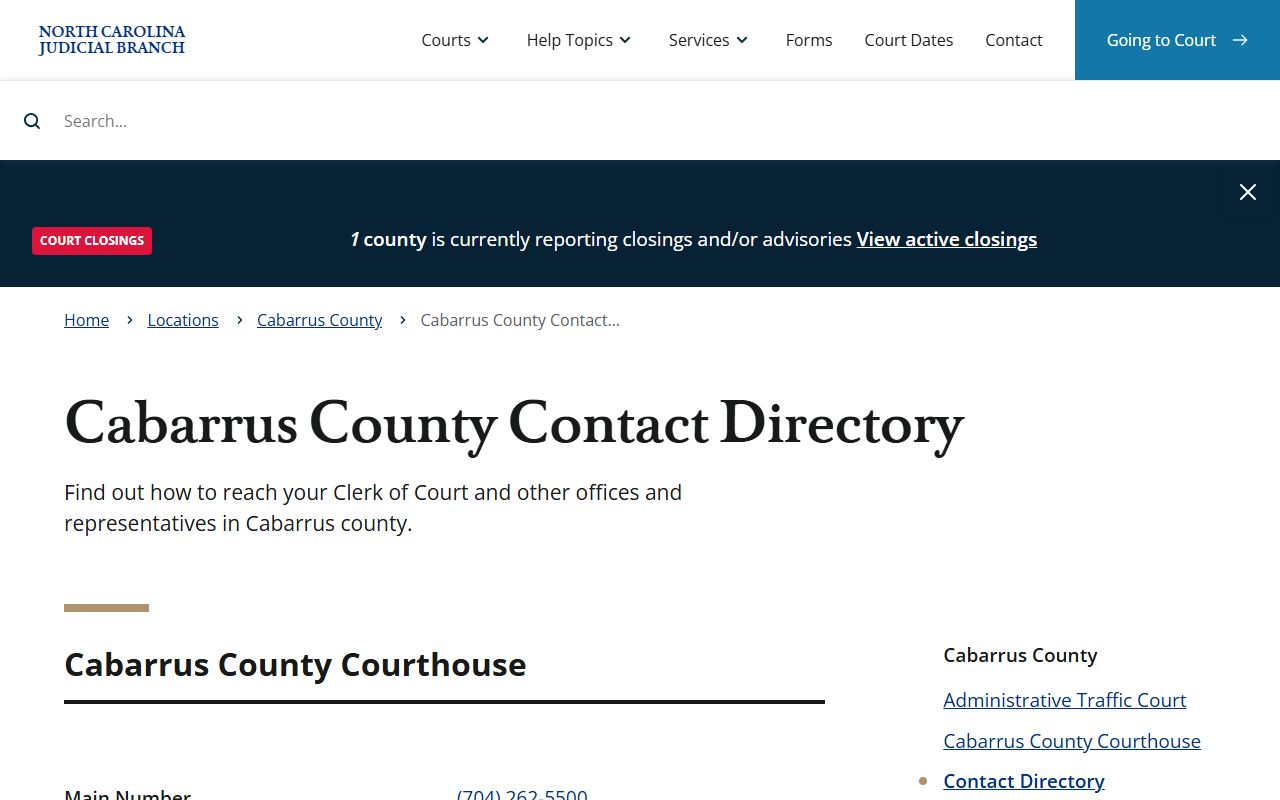
That directory lists the Clerk, District Attorney, magistrate, and custody mediation numbers for the county.
Frequently Asked Questions
How do I search Cabarrus County court records online?
Use the North Carolina eCourts Portal. Smart Search is the main tool. Search by case number or party name, then use Advanced Filtering to narrow by Cabarrus location, case type, and date. For court dates, use Search Hearings. The Portal is not the official record, so official copies come from the Clerk of Superior Court.
Do I need an account to search?
No. Registration is not required to search and view public case information. A free public account lets frequent users save cases, but it does not unlock restricted records. Elevated access is limited to attorneys and others with verified authority.
Can I bring my phone into the courthouse?
No. The official courthouse page says cell phones are not allowed. It also bans knives, scissors, sharp metal objects, firearms, ammunition, and mace. Bags and purses may be searched at the door.
More answers are on the Cabarrus County Court Records FAQ page.