
What Is a Cabarrus County Court Docket
A docket is a date-ordered record of everything that happens in a case. Each line is an event: a filing, a motion, a hearing, an order, or a disposition. In the eCourts system, the docket is called the Register of Actions. It reads like a timeline. You can trace a case from the day it opened to the day it closed without reading every document.
People often mix up two meanings of the word docket. One meaning is the case timeline just described. The other is the court calendar, the list of cases set for a given session. Both matter in Cabarrus. The case timeline tells you what has happened. The calendar tells you when the next hearing is and which courtroom to find.
For most Cabarrus cases, the docket is the fastest way to check status. It is free, it updates as the case moves, and it does not require a trip downtown. You still cannot file or pay through the timeline view itself, but you can see what the next step is and plan from there.
How to Find Cabarrus County Dockets Online
The North Carolina eCourts Portal carries both the case timeline and the hearing calendar. For case events, use Smart Search. For court dates, use the Search Hearings tool. The Portal training page describes both. You do not need an account to look.
- Open the North Carolina eCourts Portal.
- Pick the tool you need: Smart Search for the case timeline, Search Hearings for court dates.
- Enter a case number or party name. Choose Cabarrus as the location to limit results.
- Review the docket entries, hearing date, courtroom, and judicial officer where listed.
Cabarrus also posts local calendars, rules, and forms on its county court page, which helps when you want the session schedule rather than a single case.
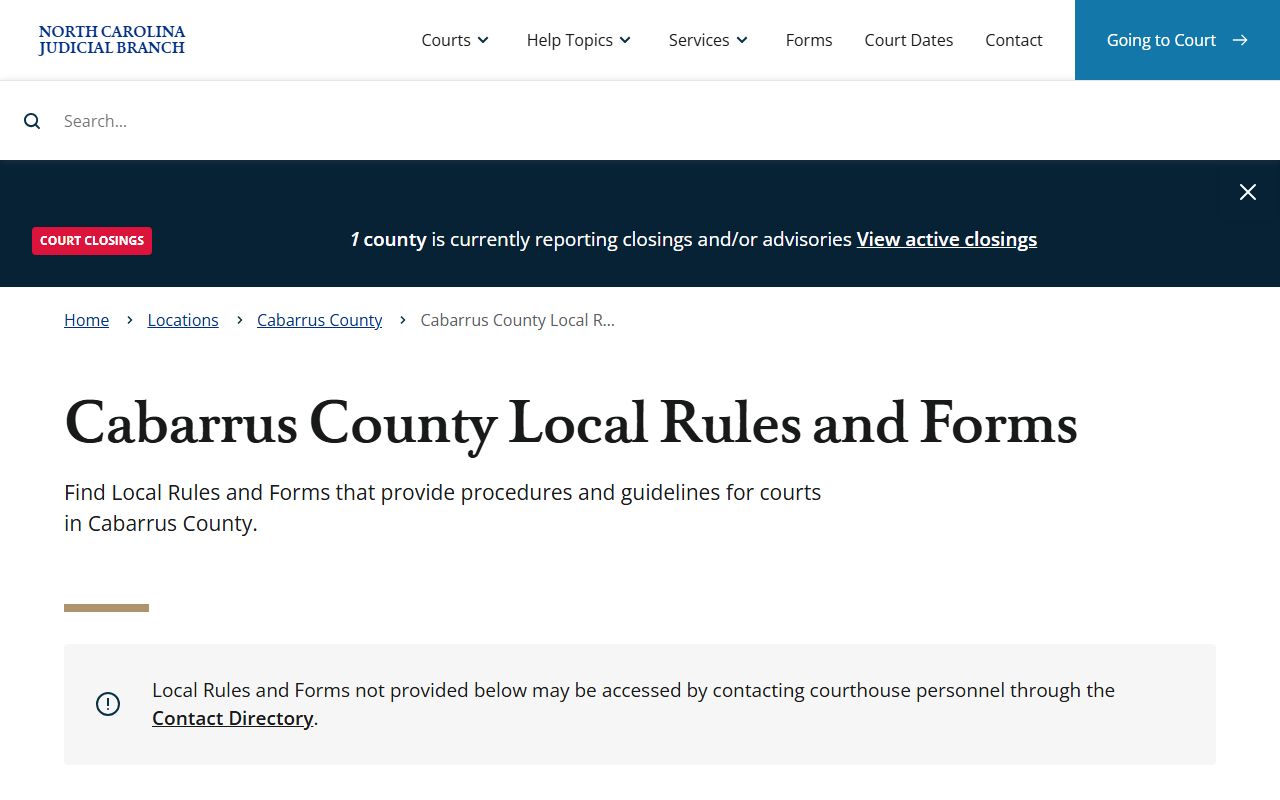
The local rules and forms page is the place for Cabarrus session schedules and filing forms.
Cabarrus County Search Hearings Fields
Search Hearings looks at current court calendars for hearing locations and times. It accepts several ways to find a case. The table lists the fields the tool supports.
| Field Label | Type | Required | Notes / Format |
|---|---|---|---|
| Case Number | Text | Optional | Finds the hearing tied to a case. |
| Party Name | Text | Optional | Searches the hearing calendar by name. |
| Attorney Name | Text | Optional | Searches hearings by attorney. |
| Attorney Bar Number | Text | Optional | Searches by NC bar number. |
| Judicial Officer | Dropdown | Optional | Filters by the assigned judge or magistrate. |
| Courtroom | Dropdown | Optional | Type the first letters to jump down a long list. |
Sample Cabarrus County Docket Entry
Each docket line carries a few pieces of data. Reading them in order shows how a case moved. The table below explains the parts of a typical entry in a Cabarrus case timeline.
| Field | What It Shows |
|---|---|
| Entry Date | When the event was recorded by the Clerk. |
| Event Type | The kind of action: filing, motion, hearing, or order. |
| Party Filing | Which side made the filing or request. |
| Disposition | The outcome when the entry closes a charge or claim. |
Document images are not always attached. The portal is public docket access, not the official file. The Clerk holds the official documents.
Courts That Publish Dockets in Cabarrus County
North Carolina runs one unified court system, so Cabarrus dockets flow through the same statewide portal rather than a local county database. Both trial courts in the county feed the system. Cabarrus sits in Superior Court District 25 and District Court District 25.
The courts and sessions that produce dockets here include the following.
- Superior Court - felony and large civil sessions, with judges who rotate every six months.
- District Court - misdemeanor, traffic, family, and small claims sessions set by the Chief District Court Judge.
- Administrative Traffic Court - the county's first and third Friday traffic calendar.
Cabarrus also publishes payment information for fees, fines, and citations, which ties to the financial entries you see on a docket.
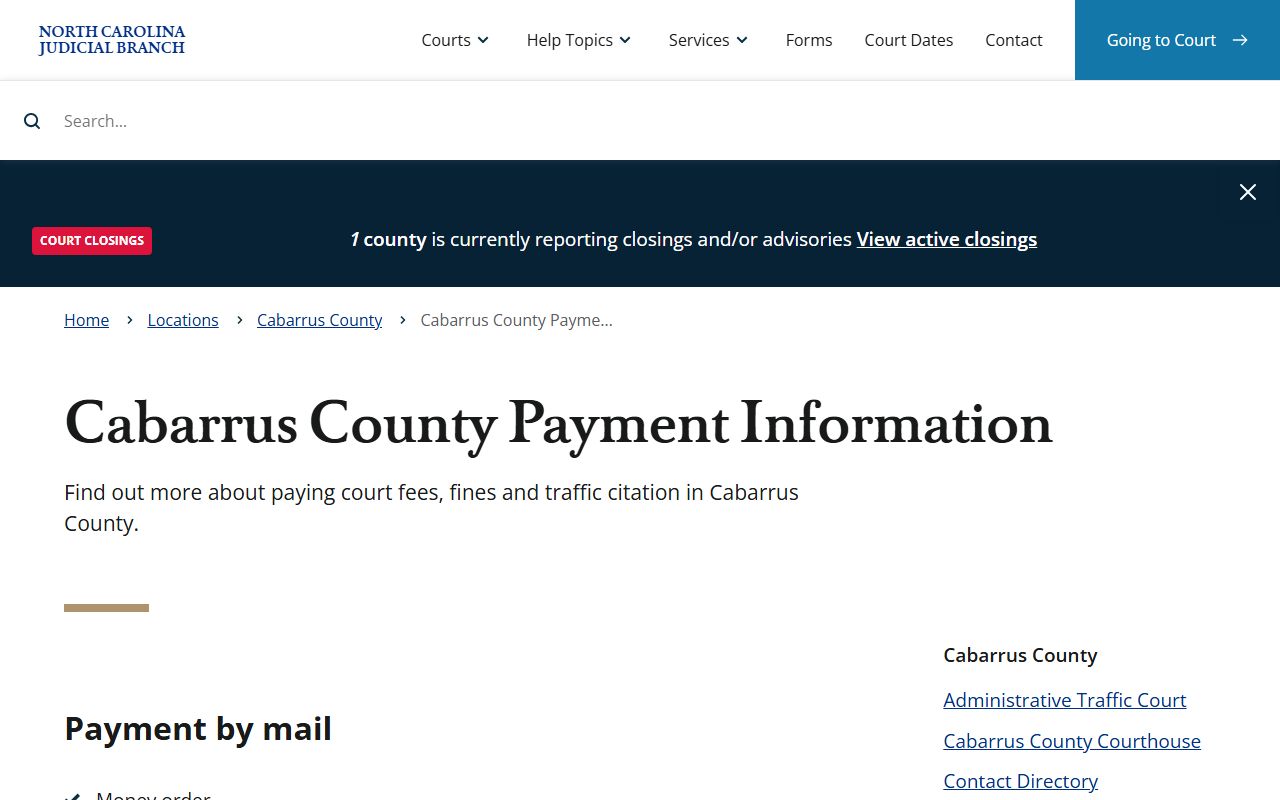
The payment information page explains how to clear costs that appear on a Cabarrus docket.
Docket vs. Full Case Record
The docket is a list of events. The full case record is the stack of documents behind those events: complaints, motions, exhibits, and signed orders. The docket is the index. The case file is the library. Knowing the difference tells you whether a quick online search is enough or whether you need to visit the Clerk.
| Docket | Full Case Record | |
|---|---|---|
| Format | List of dated entries | Full documents |
| Access | Online and free | May require a fee or a visit |
| Use | Track case progress | Legal review and certified proof |
How to Read a Cabarrus County Docket
Dockets use shorthand. The case number sets the stage. After the two-digit year, "CR" flags a criminal case and "IF" flags an infraction-only case. Inside the timeline, common events include filings, continuances, and dispositions. A continuance is a postponement of a hearing. A disposition is how a charge or claim ended, such as dismissed, guilty, or judgment entered.
Hearing entries can also list a courtroom and a judicial officer. If a date moves, the calendar updates, so always check the latest entry. Jurors who get a summons can read the county jury page for reporting and excusal rules tied to their service week.
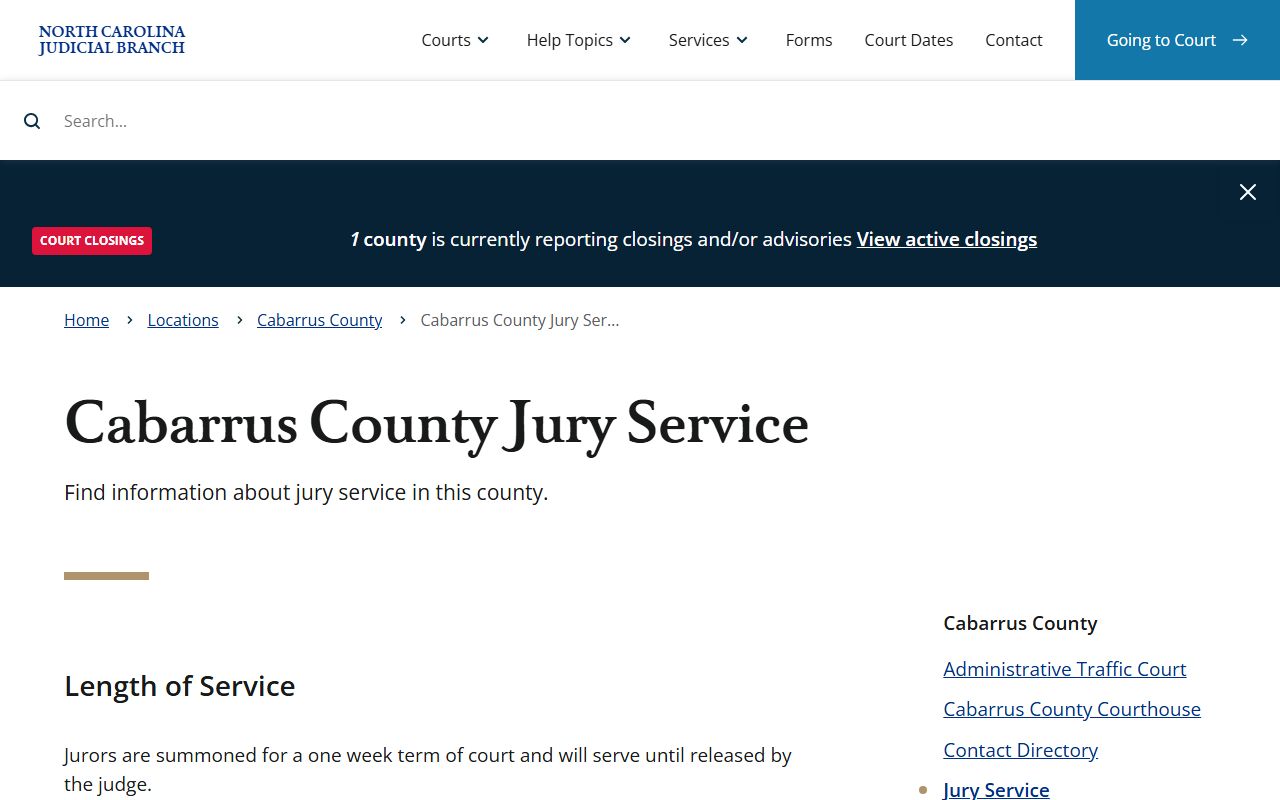
The jury service page covers the one-week term and the seven-day deferral deadline. The courthouse where these calendars are called sits in downtown Concord.

The courthouse at 61 Union Street South is where Cabarrus dockets are called, so confirm the address on your notice before you travel.
Superior and District Sessions in Cabarrus County
The two trial courts schedule sessions in different ways, and that affects when a case appears on a calendar. Superior Court judges rotate among districts every six months. District Court sessions are set by the Chief District Court Judge, who also supervises the magistrates. Because Cabarrus is in District 25 for both divisions, local sessions are organized around that district.
Calendars shift for holidays, weather, and court administration. A case set for one Friday can move to the next. The county's local rules and forms page lists the session schedule, and the eCourts hearing search shows the current date for a single case. When the two disagree, the portal entry is usually the freshest, but the official notice controls. If you plan to attend, arrive early for security screening and remember that cell phones are not allowed inside the courthouse.
What the Docket Does Not Show
A docket has limits. It will not show sealed material, juvenile cases, or victim information. It may not attach every document image. The portal is public docket access, and the Judicial Branch is clear that it is not the official court record. Restricted case types do not appear at all for public users.
So a clean docket search does not always mean a clean record. A case could be sealed, expunged, or filed in juvenile court. For anything that will be used officially, confirm with the Clerk of Superior Court at 704-262-5500 and request a certified copy rather than relying on a screen printout.